AP Music Theory practice, unit by unit
Woodshed has practice for six of the AP course’s eight units, in the College Board’s order: reading and key signatures, intervals by sight and by ear, triads and seventh chords, Roman numerals and cadences, six-four chords, and secondary function, plus harmonic dictation. Students practice free on a phone, tablet, Chromebook or laptop, with no account.
The course map and every builder are open to look at without signing in. Copying a link, printing a worksheet and the course kit come with All-Access.
What’s covered, unit by unit
This is the course map in the app, row for row. Everything under Practice now opens today. Coming means it isn’t ready yet; some of it is in the app now, marked Under development.
| Unit | Practice now | Coming |
|---|---|---|
| Unit 1: Music Fundamentals I | Note naming in treble, bass, alto and tenor clef; key signatures; rhythm counting; rhythm dictation; terms and symbols; scale degrees by ear | None |
| Unit 2: Music Fundamentals II | Minor key signatures; intervals on the staff, compound ones included; intervals by ear, melodic and harmonic; melodic dictation; sight-singing | Timbre and texture by ear |
| Unit 3: Music Fundamentals III | Triads and their inversions with figured-bass labels; seventh chords and their inversions; chord quality by ear | None |
| Unit 4: Harmony and Voice Leading I | Roman numerals in major and minor; cadences, with the Phrygian half cadence if you want it | Part writing from Roman numerals; phrase and period |
| Unit 5: Harmony and Voice Leading II | Seventh chords in Roman numerals; cadential six-fours; passing, pedal and arpeggiated six-fours | Part writing from figured bass |
| Unit 6: Harmony and Voice Leading III | None yet | Nonchord tones; motives and sequences |
| Unit 7: Harmony and Voice Leading IV | Secondary dominants; secondary leading-tone triads and sevenths | None |
| Unit 8: Modes and Form | None yet | Modes; form |
| Harmonic dictation | Four-chord progressions in major and minor: write the bass line, the soprano line, the Roman numerals, or all three | None |
| In the exam’s format | Melodic and harmonic dictation as the exam plays them: four-measure melodies written on the staff with their rhythm, scored out of 9 by segment; nine-chord progressions with the soprano and bass on the staff and Roman numerals with figures, scored chord by chord. Sight-singing with the exam’s 75 seconds to practice and 30 to sing, in any key at your own tempo, with a microphone practice check by segment and your take to play back | Part writing (free-response questions 5 and 6); harmonization (question 7); listening and score sets like Section I |
Part writing, harmonization, and the listening and score sets are in the app, marked Under development, while an AP Music Theory teacher reviews them. Until they’re ready, worksheets give students the chord spelling and Roman numeral analysis they rest on, on paper.
Try it as a student
Three free links, opened the way a student would open them. No account and nothing to install. Answers show at the end, like a quiz.
- AP mixed warm-up
8 questions: seventh chords, Roman numerals and cadences in C, G and F major and A minor.
- Unit 3: Seventh-chord warm-up
8 seventh chords on C, F and G, in root position.
- Dictation: Bass and Roman numerals
4 progressions to hear, then write the bass line and Roman numerals, in C major and A minor. Turn the sound on.
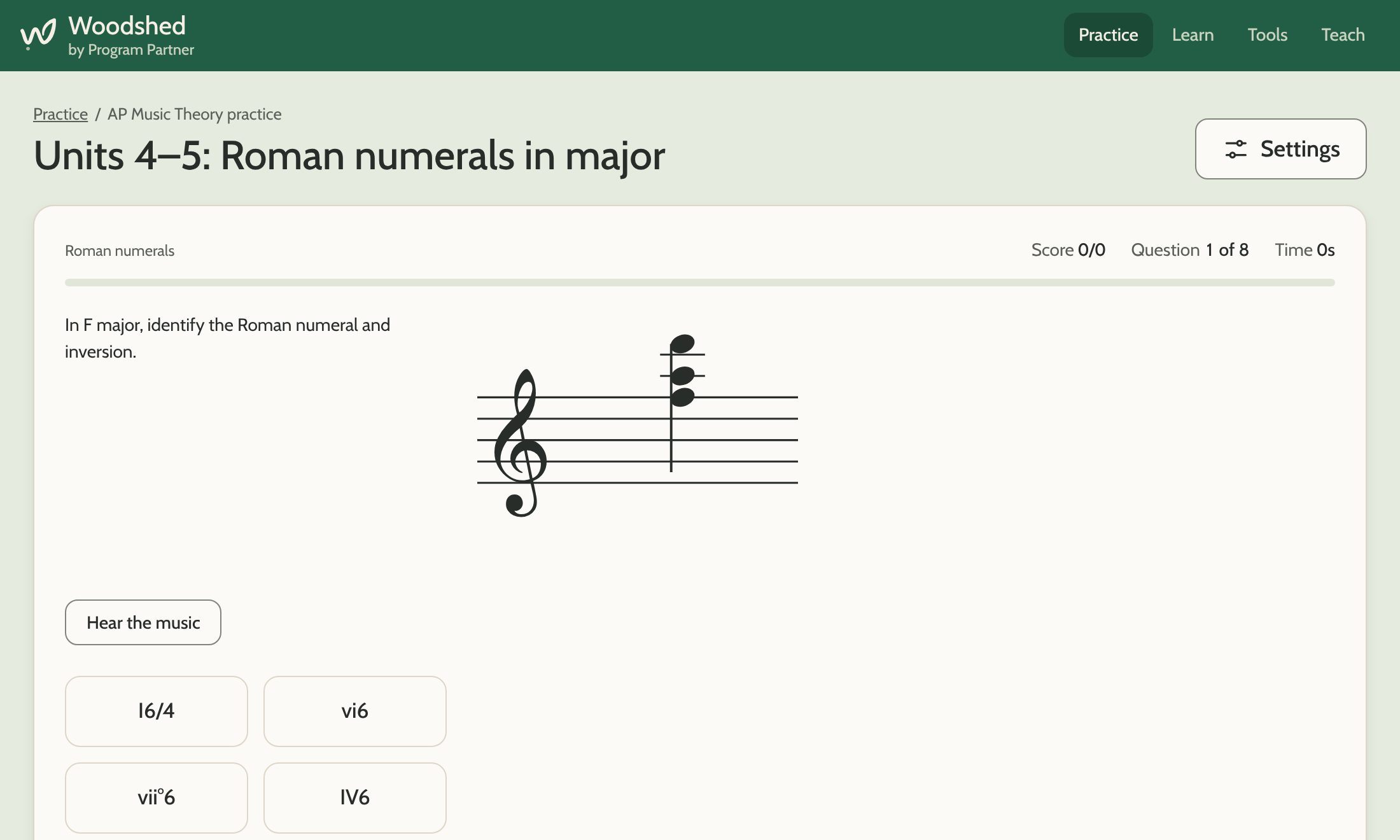
The course map
The course map lists each unit’s practice in the College Board’s order, with presets for the harmony topics and a section of harmonic dictation. Choose a row to preview it, change the keys, and send it or print it.
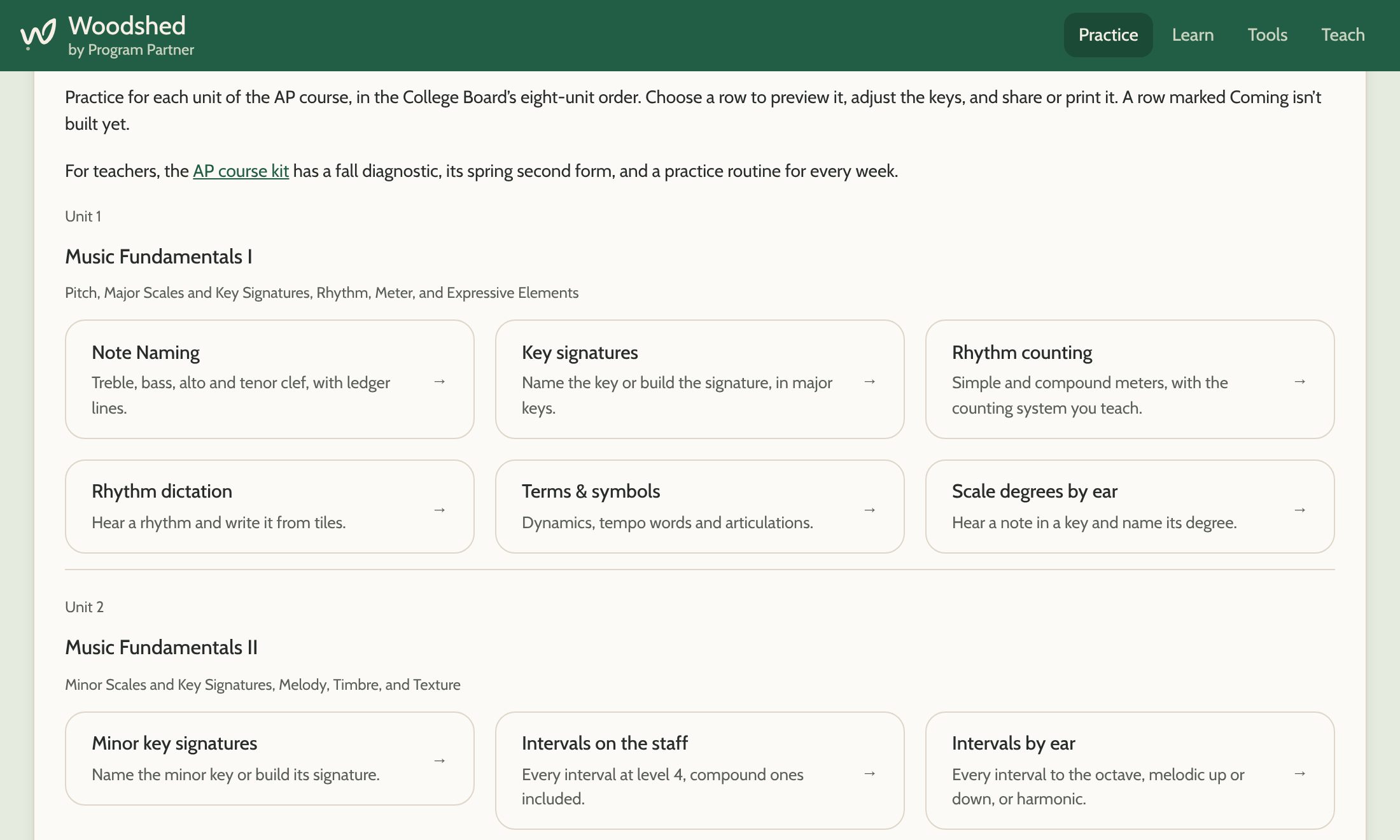
Send one link to the whole class
Choose the topic, the keys, the clef and how many questions, and whether answers show after each one or at the end. Every student who opens your link gets the same questions, so you can go over them together. Each row of the course map opens the builder with its settings filled in.
Print it, with the answer key
For a quiz on paper, or a student without a device, any AP exercise prints as a worksheet. Print up to three versions so neighbors don’t share answers. The answer key prints after the versions, a page for each.
See a sample worksheet (PDF, 3 pages)
Eight questions on seventh chords, Roman numerals and cadences, then the answer key: the AP mixed warm-up above, printed from Woodshed.
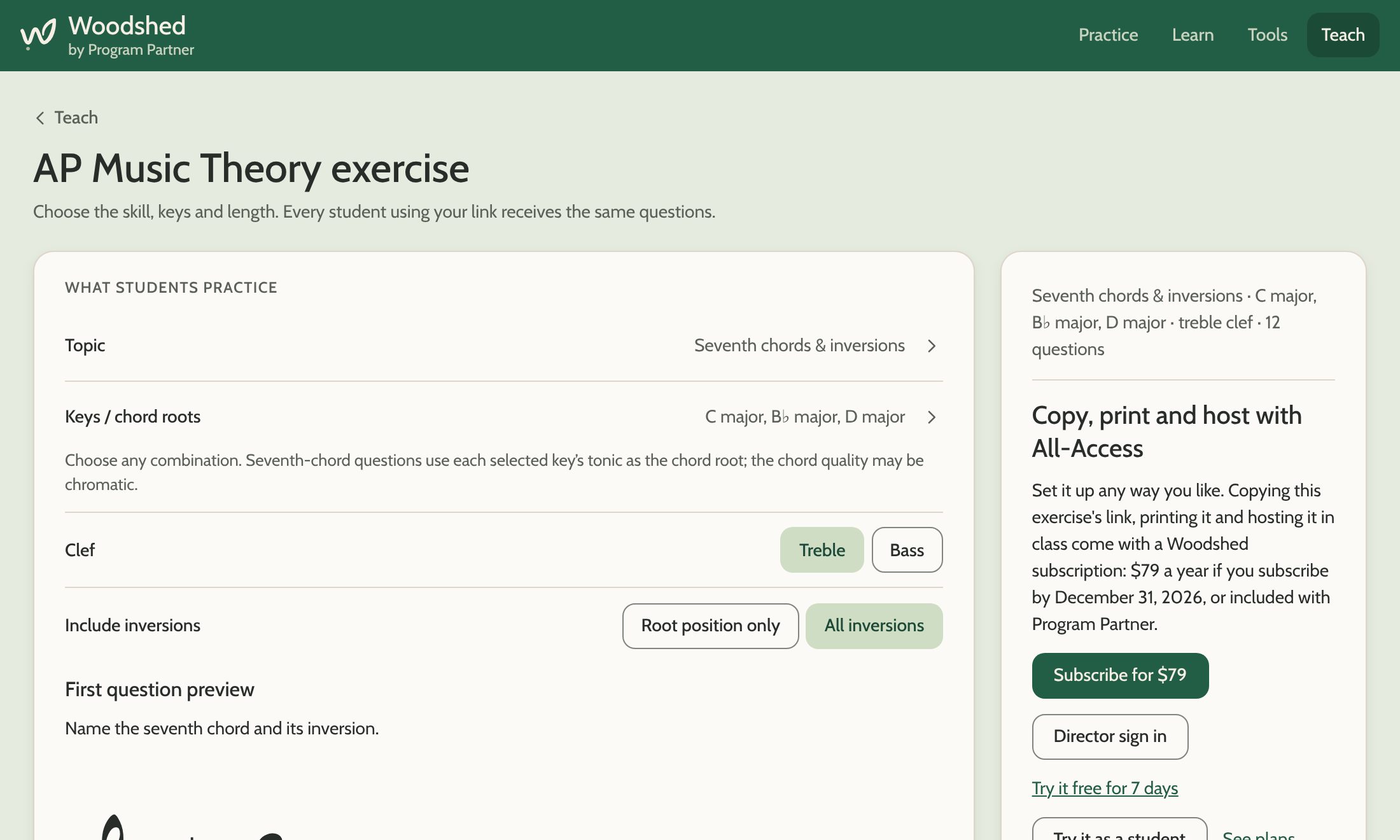
Plan the year with the AP course kit
A fall diagnostic of 8 sections and 70 questions, and a spring second form with new questions. Diagnostic results compares the two forms section by section and shows listening and written work apart. It shows where students grew, not an AP score. With them comes a practice routine for each of 30 weeks, from Unit 1 to exam review: one link a week, which you can change before you send it.
The course kit comes with All-Access.
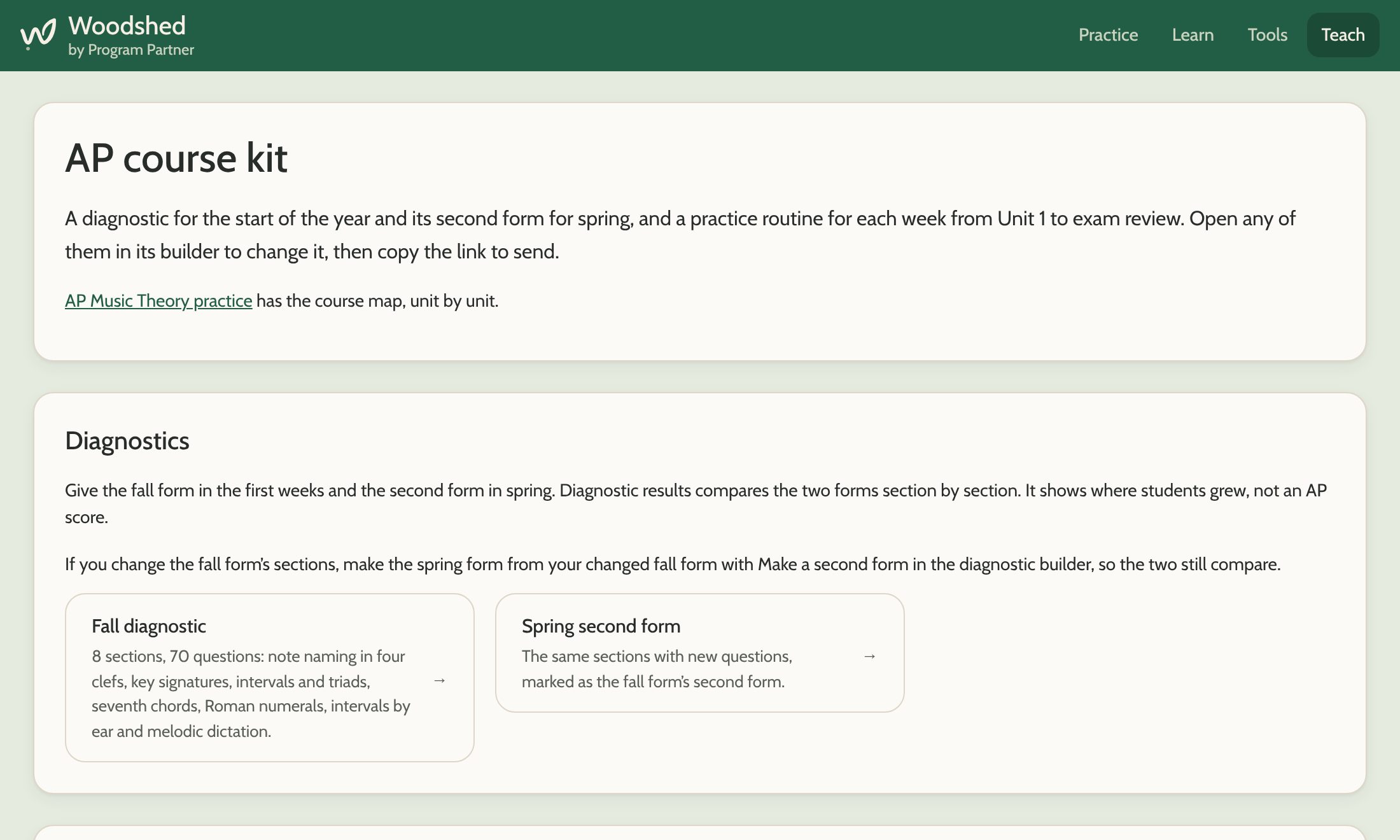
All-Access for AP and everything else
Students always practice free. All-Access is for teachers: copy links, print worksheets with answer keys, and use the course kit and diagnostics, for AP Music Theory and for band, orchestra and choir.
$79 a year per program when you subscribe by December 31, 2026, kept every year you renew. $99 a year from January 1, 2027. Included with Program Partner.
Up to three directors on one program. Need more? Email us.
Pay by card, or by purchase order with a Stripe invoice your office can pay within 30 days. After you pay, sign in to Woodshed with the same Program Partner account on each computer you build on.
Using Program Partner? All-Access is included with your Program Partner plan at no extra cost. There’s nothing to buy here. See what Program Partner does
Supplemental practice for selected AP Music Theory topics. AP is a trademark of College Board, which does not endorse this resource.